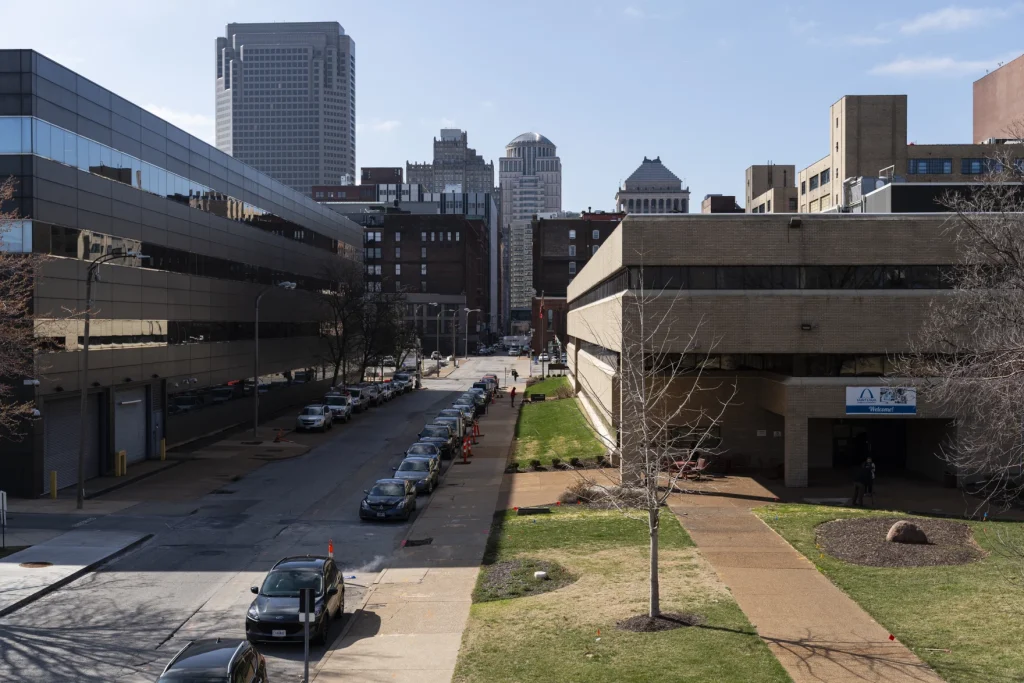
I felt more than a little apprehension. I was in morning rush hour traffic, driving to downtown St. Louis from the close-in suburb where I lived. It was something of a new experience. I hadn’t driven in rush-hour traffic since leaving Houston 25 years earlier. The apprehension wasn’t about traffic; I had stepped outside my career experience and accepted a job with St. Louis Public Schools. And I was early; the hours were 8 to 5, but I decided to be there by 7:30.
Except for nine months at a newspaper straight out of college, my career had been exclusively corporate communications: employee communications, crisis communications, media relations, environmental communications, and speechwriting. Especially speechwriting. Even for the three years I had had my own consulting business, I worked for companies, doing mostly speechwriting.
Corporations have their moments of craziness and crisis, but they pale in comparison to urban school districts. And yet, here I was, driving to my first day on the job at the largest school district in the state of Missouri, a district that had been in crisis for years and was now in hyper-crisis.
An outside management team has been authorized to take over and try to fix the massive problems the district faced – financial, academic, structural. The management team had been tasked with smashing an entrenched bureaucracy, and the bureaucracy – and all the outside people supporting it – was fighting back.
I was allowing myself to walk right into it. I’d already had the strangest job interview I’d ever had, and now I would have the strangest first day on the job I’d ever had.
I parked in the district’s garage, a short walk across a plaza from the headquarters building. I followed my instructions, introduced myself to the security team at the entrance, and accompanied one of the armed guards to a small room off the lobby, where I had my picture taken and badge created. Then I took the stairs to the second floor, where my office was said to be. Someone directed me toward the side of the building overlooking North 11th Street. The office was quite nice, just like any corporate office, and with a door. It was next to my boss’s office, but she was in an offsite meeting with all the other senior officials.
The secretary told me that I was supposed to go to Human Resources to fill out the required forms, but she said there was something else I needed to do first. Channel 5 News had asked for an interview about the teachers’ sickout.
“The teachers are having a sickout?” I said.
She nodded. “I think it has to do with changes to pensions. But they say it’s not a sickout, only hat a lot of teachers have called in sick.”
I went looking for someone to give me the background and find out what the district’s response was. I found the HR department down on the first floor, but no one there admitted to knowing anything. Someone in the academic department might know something, they said. I started looking around the building. That’s when I began to see some of the changes that had arrived.
The part of the second floor near my office was empty. There were fully equipped desks in cubicles, with tape dispensers, staplers, paper, and other office supplies, but no people. This had been the 12-member communication department. Now it was me and a half-headcount I hadn’t met yet. The people in Finance couldn’t help. No one in the academic department could say anything, because the top officials were in that offsite meeting.
The third and top floor was entirely empty except for a broadcast studio; the technician told me he was glad to meet me, his new boss. No one had mentioned that I was responsible for the broadcast studio. I would shortly learn that I was also responsible for the photography studio and archives, housed in one of the schools that had been closed. I found out that day when the district’s photographer showed up in my office to meet his new boss.
Back on the second floor, I stopped by the secretary’s desk to ask a question everyone had been vague about. What was my discretionary budget? She rather cheerfully told me that it it had been close to $1 million, but that had been reduced to $20,000. “But don’t worry about it,” she said. “The $20,000 has already been spent.”
The budget was zero. My job had become even more interesting.
I finally found someone who knew about the sick-leave policy and the issue, but they would not go on the record and never in front of a camera. I would soon learn that tended to be the official position of virtually everyone who worked for the school district – people universally saw the news media as one-way tickets to dismissal. The person did say the policy was that sickouts were illegal; people participating in them were subject to dismissal. I was warned that the principals would likely protect their staff and deny anyone had called in sick. I tested that with two principals. The assessment had been correct.
As my first hour on the job ended, I walked downstairs and outside to do an interview with Channel 5. Channels 2, 4, 11, and 30 followed. Then the St. Louis Post-Dispatch and the St. Louis American. The St. Louis Business Journal. The Riverfront Times. Several radio stations, including two independents.
That morning, I learned that I had to help TV reporters find a different location around the building so that televised reports wouldn’t look the same. That, as part of his job covering the school district, the Post-Dispatch reporter possessed and monitored a police radio. (The Post-Dispatch building was half a block away.) That School Board members, administrators, principals, and teachers all leaked like sieves to the media, parents, critics, protestors, and anyone else who’d listen.

In between interviews, I received my first phone call. It was from the St. Louis Mayor’s office, providing my “suggested” instructions for the day. I would discover that this would happen three or four times a week. The Mayor’s office was not connected in any official way to the school district. I suppose it’s okay to note now that I received my instructions politely and then ignored them. But I appreciated the effort.
By noon, I had a little time to go to HR and fill out my forms. I completed them in a small conference room and returned them to a secretary. It would be weeks before anyone owned up to those forms getting lost. The people involved knew the forms had been lost, but they were afraid to say anything. I figured it out when I didn’t receive my first two paychecks.
More interviews followed. Lunch that day happened around 3 p.m. when I found a vending machine that I had to get Security to operate because there had been too many break-ins and thefts. Yes, right there in the headquarters building, presumably by people who worked there. What had been the district’s small cafeteria had been closed in one of the restructurings that had already happened.
Toward the end of the day, the secretary brought me a catalog to order office supplies. I mentioned that I’d seen the fully supplied cubicles nearby, and couldn’t I simply take some of what was there? She looked almost horrified. “But don’t you want new supplies?” she said. I said I would scavenge first, and if I needed anything else, I’d let her know. She looked at me like I was a graverobber.
By 5 p.m., I was exhausted. The administrators had all returned from the offsite meeting, and I was able to greet several of them, including the acting superintendent, the man who’d yelled at me in the interview. He had a small team of two or three people he’d brought with him; one of them would become an island of sanity in what was clearly the craziest workplace I’d ever walked into.
If I’d only known what was ahead, I might not have come back after what had been the stranngest, most hectic first day on the job I’d ever experienced.
Related:
The Strangest Job Interview I Ever Had.
Top photograph by St. Louis Public Schools.



Might want to rethink your use of the outdated title “secretary” to describe every female working in an administrative or clerical role. Not a great way to endear yourself to your new colleagues.
More than two decades in the school district, that was the title. It didn’t change to “administrative assistant” until later.
Thanks for sharing this, Glynn. I laughed out loud again.
What a trip it must’ve been. And, “Trip” is apt because it perfectly proves a rule stated by travel writer Tim Cahill: The worse the experience, the better the story.